

Ridge and verge services
- Re-fixing loose ridge and hip tiles
- Replacing cracked and broken ridge tiles
- Dry ridge system installation
- Dry verge system installation
- Repointing and re-bedding verges
- Replacing ridges after storm damage
Why ridge mortar fails
Mortar is rigid. Roofs aren't. Over the years, timber movement, temperature changes and the weather crack the mortar beneath ridge tiles until pieces fall away into the gutters. Once the bedding has gone, the tiles are held by little more than their own weight. That's why a gutter full of mortar fragments, or ridge tiles that rock when the wind blows, should be checked before the next storm.
What the British Standard says
BS 5534, the British Standard covering slating and tiling, says mortar should not be relied on as the only means of fixing ridge and hip tiles. These tiles now need a mechanical fixing, either combined with mortar or as part of a dry fix system. Verge tiles also need mechanical fixing. A separate standard, BS 8612, covers the performance of dry fixed ridge, hip and verge systems.
A common misunderstanding is that existing mortar-bedded ridges are now illegal or must be replaced. They aren't. The standard applies to new work, so if your ridge needs re-bedding or replacing, it should be done to the current standard.
Dry ridge systems
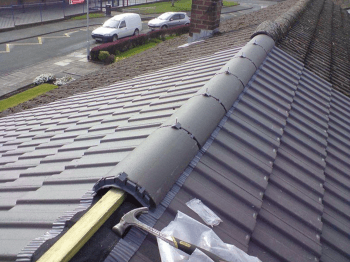
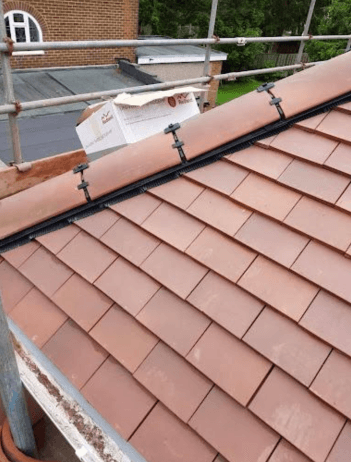
A dry ridge system replaces the mortar with a ventilated roll and mechanical fixings, usually clips or screws into a ridge batten. The tiles are held firmly in place, there's no mortar to crack and wash away, and the roll lets air out of the roof space, which helps reduce condensation in the loft. Dry ridge needs very little maintenance.
Dry verge systems
The verge is the edge of the roof at the gable end. Traditionally, the gap under the end tiles was filled with mortar, which cracks and falls out over time. A dry verge system uses interlocking caps fixed to the battens and tiles, which give a neat, uniform edge and hold the end tiles mechanically. Wind uplift tends to be greatest at roof edges, so a secure verge matters.
Mortar or dry fix?
Dry fix systems suit most modern tiled roofs and are what we'd recommend on the majority of houses in Tamworth. On some older and period properties, the look of a traditional mortar-bedded ridge is preferred, and this can still be done to the standard by adding mechanical fixings beneath the mortar. We'll talk you through which suits your roof.
Hips as well as ridges
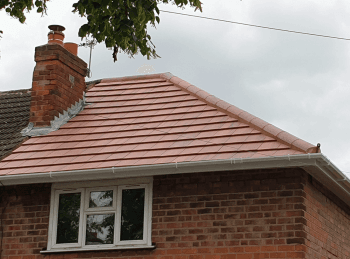
Hip tiles run down the angled corners on hipped roofs, and they suffer from the same mortar failure as ridges. Because they sit at a slope, a loose hip tile can slide down and fall from the roof. BS 5534 requires hips to be mechanically fixed too, and dry hip systems are available that work in the same way as dry ridge. Where hips are fitted, we check them as part of any ridge repair.
Areas we cover
We repair ridges and fit dry ridge and dry verge systems across Tamworth, including Amington, Wilnecote, Glascote, Belgrave, Dosthill, Fazeley, Bolehall, Kettlebrook, Hockley, Stonydelph and Two Gates.